A fresh look at price-per-square-foot data shows just how uneven Florida homebuying power can be. Using a $400,000 budget as a benchmark, a national study of the 100 largest U.S. cities finds big gaps in how much space buyers can reasonably expect, even when they stay within the Sunshine State.
The analysis, conducted by real estate analytics firm PropertyShark, uses $400,000 — roughly in line with the national median sale price — to estimate the amount of living space that price could buy in major markets. The results highlight a familiar trade-off: larger homes in more affordable metros versus smaller footprints in high-demand, high-cost locations.
Jacksonville Tops the List for Space
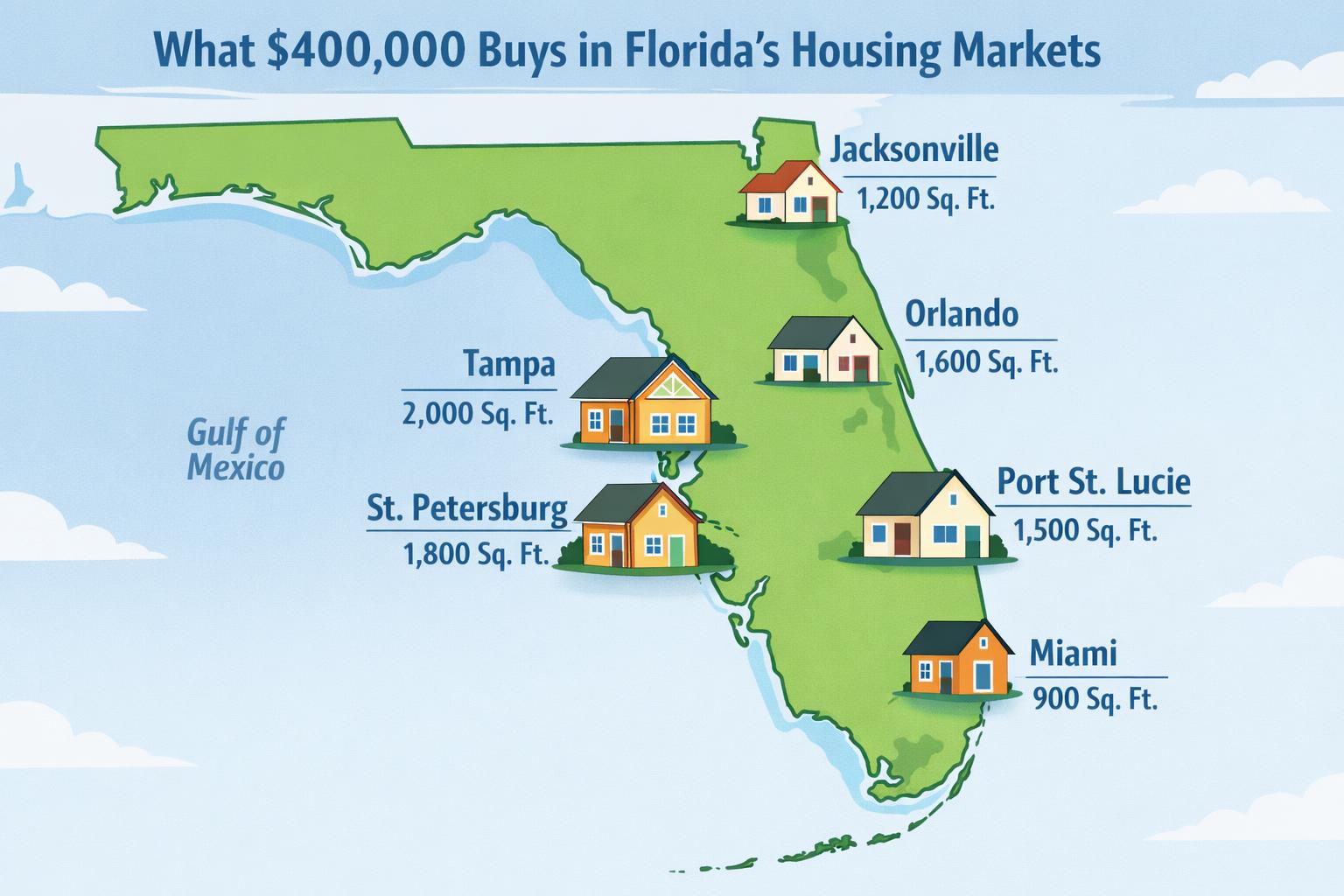
Among the Florida metros included, Jacksonville delivers the most square footage for the money. At this price point, buyers there could theoretically secure about 2,241 square feet of living space. That estimate lines up with an average cost of roughly $178 per square foot, putting Jacksonville firmly on the value side of the spectrum.
In practical terms, that kind of space typically corresponds to a full-size single-family home with multiple bedrooms and common areas, making Jacksonville attractive to buyers who prioritize square footage over headline-grabbing coastal addresses.
How Other Florida Metros Stack Up
Several other Florida cities land around the middle of the national pack, still offering family-sized homes but with fewer square feet than Jacksonville at the same $400,000 budget.
Port St. Lucie: about 1,769 square feet
Orlando: about 1,710 square feet
Tampa: about 1,554 square feet
St. Petersburg: about 1,433 square feet
These figures suggest that central and coastal metros outside South Florida still allow many buyers to get close to or above typical U.S. home sizes with a $400,000 cap. However, as square footage shrinks moving from Orlando to Tampa to St. Petersburg, the influence of tighter land supply and elevated demand starts to show up in the price-per-square-foot math.
Miami: High Prices, Limited Space
At the opposite end of the Florida spectrum is Miami. There, the same $400,000 budget would cover only about 861 square feet, less than half of what a buyer might expect in Jacksonville. The report ties this directly to Miami’s much higher estimated price-per-square-foot level, around $465.
The numbers capture the core trade-off in South Florida’s flagship market: proximity to jobs, nightlife, waterfronts and international connectivity comes with a steep premium. For many buyers, that means downsizing expectations on interior space or shifting focus to condos and smaller urban units instead of larger detached homes.
Florida in a National Context
The same PropertyShark study underscores that Florida’s wide range of outcomes mirrors even larger national divides. In parts of the Midwest, $400,000 still stretches a long way. Detroit stands out in the report, where that budget could theoretically command close to 5,000 square feet of housing — more than double what buyers might find in many Florida metros.
On the other side are dense coastal hubs, where land constraints and persistent demand drive costs sharply higher. In Manhattan, the analysis estimates that $400,000 would only buy about 267 square feet, roughly the size of a compact studio. Compared with Miami’s 861-square-foot estimate, that underlines how Florida’s priciest big city still offers more space than some of the country’s most constrained markets.
Methodology Behind the Square-Footage Benchmarks
To build the city-by-city comparisons, PropertyShark relied on 2024 Census population estimates to identify the nation’s 100 largest cities. It then drew on its own sales records, verified against local multiple listing services, to calculate typical prices per square foot.
By dividing a fixed $400,000 budget by those price-per-square-foot figures, the researchers estimated how much interior space a buyer could theoretically purchase in each market. While individual properties will differ, the approach offers a clear, apples-to-apples snapshot of how location alone reshapes what buyers can expect to get for the same amount of money.
What It Means for Florida Buyers and Sellers
For Florida shoppers, these findings reinforce the importance of thinking beyond list prices and focusing on cost per square foot. A $400,000 cap in Jacksonville opens doors to significantly more living space than the same budget in Miami or St. Petersburg. Buyers willing to trade a marquee coastline for a less expensive metro can often step up in size or neighborhood quality.
Sellers, meanwhile, can use these benchmarks to frame their pricing strategies and marketing narratives. In lower-cost metros, emphasizing the amount of space and value relative to higher-priced Florida cities may resonate with buyers relocating from coastal markets. In premium locations, highlighting lifestyle, walkability and amenities can help justify smaller footprints at higher price points.
As affordability pressures continue to steer migration patterns within Florida and across state lines, the square footage a budget can buy is likely to remain a central consideration for both local and incoming buyers.