Energy moves from background cost to frontline market driver
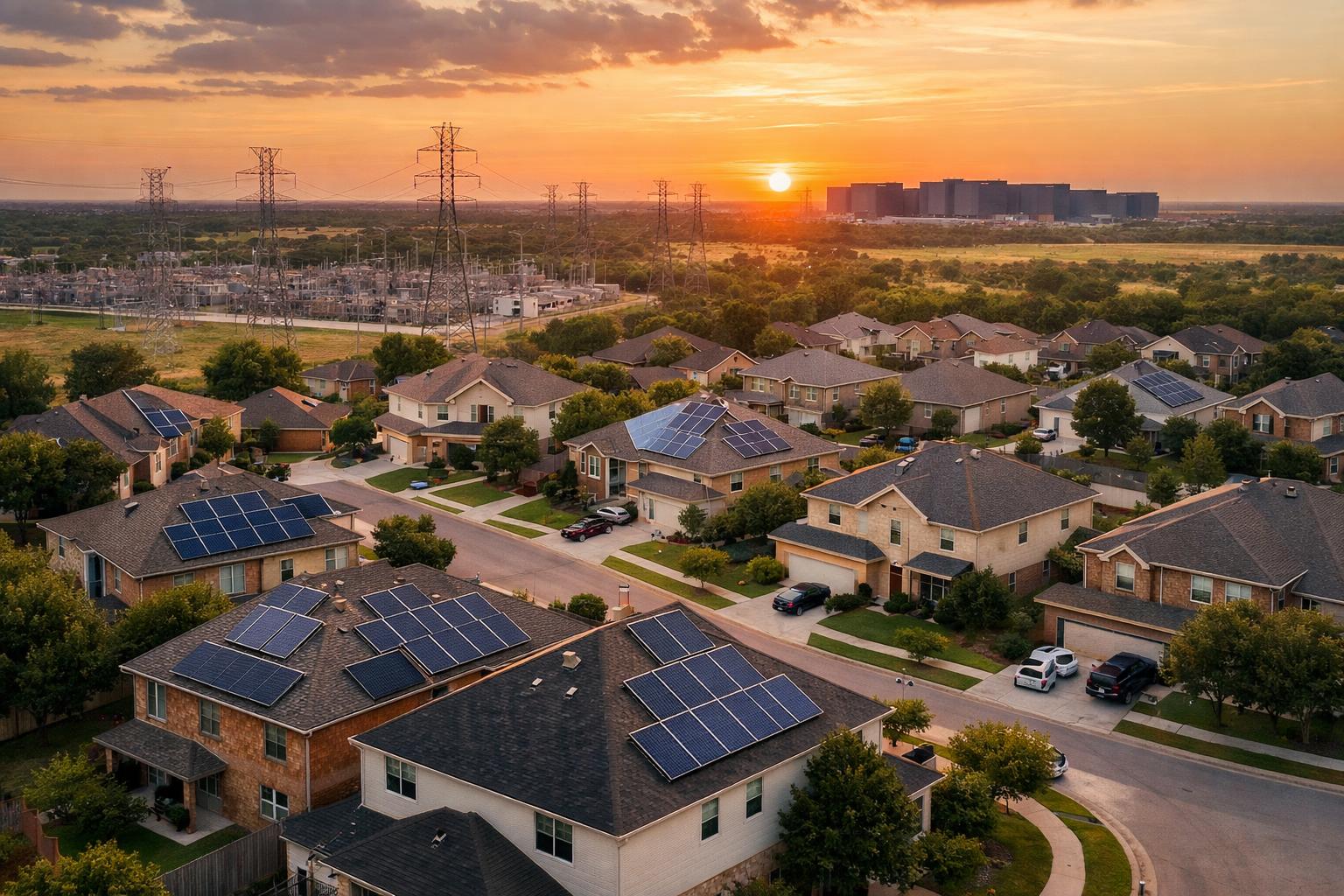
Energy used to be something most homeowners noticed only when the monthly bill arrived. That is rapidly changing. Rooftop solar, home efficiency ratings, batteries, local microgrids, and power-hungry AI data centers are now influencing property values, insurance availability, and even national climate strategy.
For real estate professionals and homeowners, that shift means energy choices are increasingly intertwined with equity growth, borrowing power, and long-term housing resilience.
Solar’s value premium: measurable, but uneven
Cotality’s Australian research, summarized in its “Watts it Worth?” report, highlights how rooftop solar is being priced into the housing market rather than treated as an invisible bonus feature.
National uplift: Homes with solar in Australia showed an average value bump of about 2.7%, roughly a little over A$20,000 (around US$13,000).
City vs. regional spread: Major cities tended to sit in the 2–3% premium range, but some regional areas saw gains approaching 7%, with parts of the Northern Territory around 6.9%.
Efficiency ratings matter too: A one-star improvement in the national energy efficiency rating system was associated with roughly a 1.6% value increase, showing that “hidden” features such as insulation can move prices alongside visible panels.
In the U.S., Cotality notes that multiple independent studies, including work from Lawrence Berkeley National Laboratory, typically find a solar price premium in the 2–6% range. That bump tends to be largest where retail power prices are high, where buyers actively seek out green features, and where systems are newer and more efficient.
When do owners actually feel the payoff?
From a homeowner’s point of view, the timing of benefits matters as much as the headline value premium. Most of the equity bump appears when the property is sold or refinanced. Until then, the relevant question is whether lower utility bills justify the upfront cost.
Typical payback in Australia: A basic rooftop system without a battery often costs in the neighborhood of A$10,000–A$15,000, depending on size, state-based rebates, and local conditions. For many households, Cotality’s experts suggest a payback window of roughly five to seven years, faster for heavy users with big power bills.
Similar dynamics in the U.S.: The U.S. experience broadly mirrors that pattern: marketing emphasizes bill savings, but realized performance is highly sensitive to household behavior, local tariffs, and whether retrofits or electrification are needed.
Refinance angle: Where appraisers and lenders recognize the added value from solar and efficiency, the improved valuation can push a borrower into a better loan-to-value bracket, potentially unlocking lower mortgage rates.
One recurring theme is uncertainty: many installers rely on generic savings models that may not capture how a particular family actually uses power. That makes robust, property-specific modeling an emerging competitive advantage.
Resilience, risk, and insurance: solar is not always a free win
Solar’s interaction with insurance is becoming a critical but often overlooked variable in the cost–benefit equation.
Resilience upside: Systems that pair panels with battery storage can provide backup power during grid failures, a feature that buyers increasingly value in hazard-prone areas.
Damage and premium risk: Panels can also increase the cost and complexity of post-disaster repairs, particularly after wind, hail, or wildfire. In some cases, that can push premiums higher.
Carrier-by-carrier rules: Some insurers roll panels into the standard policy with little change in cost, others require separate endorsements, and a few may decline coverage in high-risk territories.
Install details matter: Whether panels are roof-mounted or ground-mounted, and how they are classified (part of the main dwelling vs. separate structure), can affect coverage terms.
Cotality’s survey work suggests that homeowners value comfort and clarity around coverage even more than convenience, underscoring the need for buyers to understand how a retrofit might alter their insurance position before they sign a solar contract.
Household economics sit inside a larger climate risk story
Beneath the individual calculus on solar and efficiency is a wider concern: climate-driven damage and the fragility of the housing system.
Exposure today: Cotality estimates that about 12% of current U.S. housing stock faces a very high risk of natural disaster damage absent meaningful adaptation.
Future exposure: Without adjustments, that share could rise to roughly 20%, placing more homes and mortgages in the crosshairs of severe weather.
Rebuild vs. resilience costs: Reconstructing all highly exposed properties is pegged around US$7.2 trillion, far more than the hundreds of billions the firm says would be needed to build resilience into the property system up front.
For lenders, insurers, and policymakers, those numbers frame energy upgrades not just as a climate play, but as a financial stability issue. If insurance becomes unaffordable or unavailable in large swaths of the country, credit risk and home values follow.
From single homes to community-level energy strategy
Scaling the benefits of renewables requires moving beyond one-off rooftop projects to coordinated, data-driven community programs. The challenge: not every home is equally suited to solar, and not every household uses energy in the same way.
Local climate variation: A cloudy coastal market and a sunny inland market can’t expect identical solar yields.
Building stock differences: Age, insulation quality, and mechanical systems all change the payoff profile for the same size array.
Behavioral patterns: Thermostat settings, occupancy, and appliance use can upend generic savings forecasts.
Cotality points to work underway in the United Kingdom, where the government has adopted a standardized model to estimate home energy use and savings potential as part of its 2050 net-zero goal. That framework combines detailed property assessments, upgrade plans, and in some cases sensors to validate real-world performance. Although that initiative is UK-specific, it illustrates how standardization and verification can support large-scale, targeted retrofit programs.
Australia’s policy push: rebates, ratings, and grid relief
Australia has quietly become one of the world’s denser rooftop solar markets, with Cotality noting that about one in three homes already has panels. Policy design has been central to that build-out.
Rebate schemes: Federal and state governments have set aside funds to offset solar installation costs, accelerating adoption.
Construction standards: The National Construction Code embeds energy-efficiency expectations into new housing, while solar helps reduce net grid draw, even if it does not itself improve the underlying efficiency of the structure.
Existing homes focus: Recent “existing home trials” are testing more consistent methods to rate the vast, older housing stock, which remains the largest driver of energy demand.
Financing support: A 2023 federal initiative channeled around A$1 billion through the Clean Energy Finance Corporation to help lenders offer discounted rates for upgrades ranging from panels and batteries to EV chargers and improved insulation.
Cotality’s research even highlights a new subdivision where more than 99% of homes include solar, offering a glimpse of what a near-universal rooftop buildout could look like if incentives, regulation, and market demand align.
Commercial property and AI: a new strain on the grid
Residential rooftops are only part of the energy story. Commercial real estate is also changing under the pressure of rising demand and new digital infrastructure.
In Australia, office and industrial buildings participate in the NABERS program, which tracks both design efficiency and actual ongoing energy use. That gives owners, tenants, and financiers clearer visibility into operational performance and potential retrofit benefits.
In the U.S., Cotality points to the rapid growth of AI-focused data centers as a looming driver of electricity demand. Research from the Electric Power Research Institute suggests that centers powering advanced AI models could account for up to about 9.1% of total U.S. energy demand by decade’s end, up from roughly 4% today.
That escalation puts data centers in direct competition with households for power and risks pushing utility rates higher. Policy responses range from building new generation and transmission—capital-intensive and slow—to encouraging more distributed solar at the household and community level as a partial buffer against higher bills.
U.S. policy: big ambitions, legal headwinds
Federal climate policy in the United States in recent years has leaned heavily on incentives designed to channel private capital into clean energy and efficiency projects.
Greenhouse Gas Reduction Fund: Established under the 2022 Inflation Reduction Act, this program set aside tens of billions of dollars to underwrite clean energy investments, including residential retrofits and commercial projects.
Design goals: The fund was meant to ensure that projects deliver concrete household benefits such as lower bills and improved property values, not just emissions reductions on paper.
Current status: Portions of the program are paused amid litigation, although technical work continues to build the analytical tools needed to evaluate projects and protect homeowners from uneconomic retrofits.
State-level role: With federal activity constrained, states are expected to take on a larger share of the policy load, from incentives to building codes and utility regulation.
Across these efforts, a consistent through line is the attempt to make clean energy upgrades both financially attractive and broadly accessible, rather than a niche product for higher-income or early-adopter households.
What this means for U.S. housing and real estate players
For the U.S. housing market, the trends Cotality describes in Australia and abroad point to several practical implications.
Appraisal and valuation are changing: Solar, verified efficiency improvements, and resilience features are increasingly material to sale prices and refi valuations.
Financing is evolving: Green mortgages and preferential-rate upgrade loans are likely to spread, especially as data improves on actual savings and default behavior.
Insurance will be a gatekeeper: In high-risk regions, the interaction between rooftop systems and hazard exposure could shape who can afford to insure and therefore own certain homes.
Developers face new baselines: Subdivisions built with near-universal solar or high efficiency standards are already emerging overseas and could foreshadow U.S. buyer expectations.
Policy uncertainty is a risk factor: Legal and political swings around federal climate tools introduce volatility that lenders, investors, and local governments will need to manage.
The underlying direction, however, appears consistent: energy performance and resilience are becoming core components of real estate economics, not optional add-ons. As AI-driven demand rises and climate risks mount, the homes and buildings that can generate, store, and use power efficiently are likely to command a growing premium in both price and policy support.